
Not myth or legend; The Blue People of Kentucky were an isolated enclave of Appalachian people who lived with an embarrassing skin discoloration until a young hematologist took notice and found a solution. As the story goes, Martin Fugate, a French orphan, settled on the banks of eastern Kentucky's Troublesome Creek around 1820 to claim a land grant. He married a red-haired American named Elizabeth Smith with a very pale complexion. Little did they know that their union would create shades of blue people!
Generations later, a descendant of Martin Fugate, Benjy Stacy, would be born 'blue'. 'He was almost purple,' his father, Alva Stacy, recalls.' Benjy was born in a maternity ward near Hazard, Kentucky and was rushed by ambulance to a medical clinic in Lexington to find help for his blue problem. Days of testing provided no answers; but then Benjy's grandmother told the doctor a story about the 'blue' Fugates. Incredibly, Benjy had inherited a gene dating back over 162 years! Thankfully, Benjy lost his blue shade after a few weeks and the only lingering effects were blue fingernails and lips when he was cold or angry.
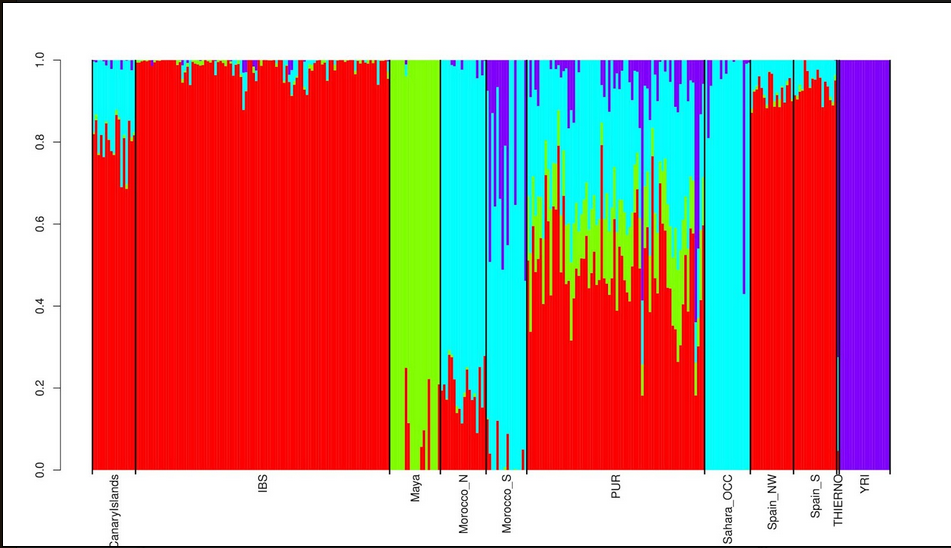
I was shocked when it revealed that I was 24% Nigerian, 17% England, Wales, NorthWestern Europe, 10% Portugal, 2% Spain, 1% Indigenous Puerto Rico, Indigenous Haiti, Dominican, French and so on. My family is from the island so reading history this does not surprise me that there are indeed a variation of Puerto Rican’s. The keynote speaker was Don R Anderson, who is the head of the Family History Library and Family History Support. I also took 2 other classes taught by him. In one of the classes, he was asked this very question, if the church would ever set a time limit when temple cards people hold would 'expire' and become available for someone else to do.
In the early 1960's, this blue malady caught the attention of Madison Cawein, an inquisitive hematologist from the University of Kentucky. Curiosity drove him to Hazard where he was introduced to a nurse, Ruth Pendergrass, who had met a 'dark blue' woman. She was one of the 'blue' Combses who lived up on Ball Creek and was a sister to one of the Fugate women; her brother, Luke, was also blue. The search for blue people ensued. Patrick and Rachel Ritchie, who lived in Hardburly, were also blue. Cawein eventually found a small population of people in the back woods of Appalachia, many with a blue skin disorder. The afflicted were embarrassed about their condition and adamant about talking to Cawein. Eventually, Cawein gained their trust and began taking blood samples. Tests for abnormal hemoglobin were negative. Then he began to construct the family genealogy and traced their roots back to Martin and Elizabeth Fugate.
Tracing Blue People Ancestry
Cawein was determined to find a cause and possibly a solution to help this small group of isolated Appalachian people. In his research, he found a 1960 article by E. M. Scott that was reported in the Journal of Clinical Investigation. Scott's research had found hereditary methemoglobinemia among Alaskan Eskimos and Indians caused by an absence of the enzyme diaphorase from their red blood cells. Methemoglobinemia is a rare hereditary blood disorder that results from excess levels of methomoglobin (metHb) in the blood. 'Methomoglobin is an oxidized form of hemoglobin that has a decreased affinity for oxygen, resulting in a reduced ability to release oxygen to tissues.' This results in brown blood giving Caucasian patients a bluish hue to their skin.
The blood disorder is inherited as a simple recessive trait - meaning that to get the disorder, a person would have to inherit two genes, one from each parent. One could inherit the gene, not get the blood disorder, but pass the gene on to a child. The gene would most likely appear in an inbred line. Martin Fugate carried the recessive gene and the odds that he could have married a woman with the same recessive gene were overwhelming - but that is exactly what happened.
Fortunately, Cawein was able to find an antidote for the blood disorder - methylene blue which acted as an electron donor. The antidote worked quickly but patients were required to take daily doses as it passed quickly through the urine. At last they were free of their 'blue' shade and were no longer embarrassed.
Cawein, in researching the family lines in Perry County, Kentucky and with the help of Fugate Family Bibles, found in fact, that the Fugates had married Fugates, had married first cousins, and had intermarried with families whose surnames were: Combs, Smith, Ritchie, and Stacy. They lived in isolation and married the girl next door, even if they had the same last name, and consequently passed the gene on to many generations. Martin and Elizabeth had seven children, four being born blue; Zachariah, who was blue, married his mother's sister. Written family records do not indicate Martin's skin color, but family legend says he was blue. Eventually, the recessive gene began to disappear once coal mining and the railroad opened the community to outsiders. This small enclave was no longer isolated and they began to disperse and marry outside of their little clan diminishing the effect of the 'blue' gene.
In online research, there was no mention made of 'blue' people as recorded in the genealogy book, The Fugate Family of Russell County Virginia, published in 1986, but it has been confirmed in the Fugate discussions on the Genforum. It is almost certain that Martin was a descendant of the Fugate family of Russell County, Virginia and probably of French origin. It is documented that Fugates were born in the colonies in the mid 1600's but the original progenitor has not been confirmed. Different spellings of the surname sometimes include 'Fugett' and 'Fugitt'. Mary (Dawley) Fugate, who answers quite a few queries and also helped compile the genealogy book, indicates that the siblings of Martin Fugate were not blue but he must have been a carrier. She also states that the union of Martin and Elizabeth were probably not the originators of the gene as their marriage took place too late. There was a Zachariah Fugate who was married to a Mary Smith; both carried the gene which resulted in blue children. Mary Fugate said that the gene is very dominant in the Smith line but there is still no concrete answers as to what couple started the shades of blue people.
Blue People Family History Resources
Faris, David. The Fugate Family of Russell County, Virginia: A Genealogy of the Descendants of Francis, Benjamin, Colbert, Zachariah, Henley & William Fugate, Settlers of Moccasin Valley from 1772. (Baltimore: Gateway Press 1986). Book is out of print, borrowed from Special Collections at the St. Louis County Library, St. Louis, MO.
I had to think over who I wanted to write about and drew a blank because there are so many I’d like to write about. Since I’m still working on both my Puerto Rican and Dominican ancestry, I figured I’d talk about the benefits of having your DNA tested. First I recommend an Autosomal DNA test; its an inclusive test that will let you see relatives from both maternal and paternal line. The test does not advise you if a person is related to you maternally or paternally. To determine this requires working with the individual and finding the connection.
Currently there are 3 main companies I recommend you chose from; FamilyTreeDNA, 23andMe, and Ancestry. The reason for this is that you can upload your raw DNA data file to a website called GEDMatch which offers you many free tools to analyze your DNA and allows you to find relative connections that have tested with one of these companies.
I personally have tested with two companies so far; 23andMe and Ancestry. I will speak to FamilyTreeDNA in a moment and what I’ve done. It is totally up to you which route you take.
One of the main things I need to point out about DNA testing, its NOT going to tell you how you’re related to an individual. It provides predictions on relationship levels and that is based upon the number of centimorgans (cM) and SNP’s that match an individual; centimorgans are the distance between chromosome positions. The number can be off if you’re related more than once. This occurs when you are related to an individual on more than one family line.
Genes Are A Funny Thing..puerto Rican Genealogy Groups
I’m not going to get into the discussion of cM because it is very involved. A great place to start in learning about DNA is by visiting The International Society of Genetic Genealogy website (www.isogg.org). This website provides detailed information about DNA testing as well as comparisons between the different companies out there. The website lists other companies available for testing. See their welcome page link below and you’ll find the comparison charts on the right side of the page on the different types of tests:
Testing is not too expensive if you go with any of these three. Each has their plus and minuses depending on what it is you seek and your race/ethnicity. The consensus is that if you’re Puerto Rican or Dominican then 23andMe may be your best option. It is also a great website if you suspect African ancestry. There is a large amount of Puerto Rican and Dominicans that are testing with this website and with the matches I’ve found I’ve been able to accurately continue to build my Dominican family tree. It has also provided confirmation that what I’ve documented is accurate based on those that match me.
I’ve found 23andMe’s test to be more accurate in identifying countries of origin since I’ve done my genealogy tree that goes back many generations; some lines going back to the 1500’s on my Puerto Rican side. However if you’re looking to make your dollar stretch, then I recommend Ancestry. Why is that? Well for one you can compare notes with those who have their family tree built on the website. Another reason is that you can easily download the DNA file and upload it to FamilyTreeDNA, thereby getting a two for one. What is lacking on Ancestry is tools to manipulate your data. They simply supply you with your genetic makeup based on their algorithms. Here is a sample of what mine looks like on Ancestry:
| Ancestry Results |
I can assure you that I’m not 35% Italian/Greek. I found that to be laughable; not that I have any issue with being part Italian or Greek because 23andMe found Italian DNA ancestry but at around 1%. Had I not done by genealogy tree and documented my ancestry well I would have been fooled into thinking I’m mostly Italian/Greek. I also know that I have a Syrian great grandfather that migrated in the 1800’s, no indication on this screen.
Now as for 23andMe, I must say the website has some great tools but is lacking in others; however it’s a start. Once you familiarize yourself with the website, you can see which segments of your chromosomes and what regions of the world a person matches with. The person must be sharing their DNA with you to determine this.
Now here is the test results screen that is comparable to Ancestry’s website. The difference is that it was much more accurate, provides you with three different view on the map alone. In addition if you had a parent tested, it provides you a split view of your chromosomes. Since my father is deceased I can’t have that test done unless I get my brother to test. I’m also providing the chromosome view that goes with the country percentages to the right of the first screenshot.
| 23andMe Country of Origin View |
Genes Are A Funny Thing..puerto Rican Genealogy Sites
| 23andMe Chromosome View |
Genes Are A Funny Thing..puerto Rican Genealogy Society
Hope this provides insight into which test to go with and where to find information on testing. I leave you with my Neanderthal DNA that 23andMe found; another perk! This may explain the need to shave all the time. LOL!!!
Genes Are A Funny Thing..puerto Rican Genealogy Site
| Neanderthal DNA |
